

Advent: December 2 – Waiting Is an Art

Celebrating Advent means learning to wait. Waiting is a skill that our impatient world has forgotten. Today, people want to pick the fruit before the plant has even grown. But often, they are disappointed; the fruit that looks so good on the outside is still unripe inside. Impatient hands throw it away because it did not meet their expectations. Those who do not understand the blessing of waiting—of hoping and doing without for a time—will never truly enjoy the joy of fulfillment.

People who have never struggled with the deepest questions of life and waited patiently for answers cannot imagine the beauty of the moment when they finally understand. Those who do not patiently seek friendship and love—who do not open their hearts and wait for these things to grow—will never know the true joy of two souls deeply connected in friendship and love.

The greatest, deepest, and most delicate things in life require waiting. These things do not come quickly or easily. They grow according to divine laws of planting, growing, and becoming.

Be brave for my sake, dearest Maria, even if this letter is your only token of my love this Christmas-tide. We shall both experience a few dark hours—why should we disguise that from each other? We shall ponder the incomprehensibility of our lot and be assailed by the question of why, over and above the darkness already enshrouding humanity, we should be subjected to the bitter anguish of a separation whose purpose we fail to understand.… And then, just when everything is bearing down on us to such an extent that we can scarcely withstand it, the Christmas message comes to tell us that all our ideas are wrong, and that what we take to be evil and dark is really good and light because it comes from God. Our eyes are at fault, that is all. God is in the manger, wealth in poverty, light in darkness, succor in abandonment. No evil can befall us; whatever men may do to us, they cannot but serve the God who is secretly revealed as love and rules the world and our lives.

Letter to fiancée Maria von Wedemeyer
from prison, December 13, 1943

A shoot shall come out from the stump of Jesse,
and a branch shall grow out of his roots.
The spirit of the Lord shall rest on him,
the spirit of wisdom and understanding,
the spirit of counsel and might,
the spirit of knowledge and the fear of the Lord.
His delight shall be in the fear of the Lord.
He shall not judge by what his eyes see,
or decide by what his ears hear;
but with righteousness he shall judge the poor.

Isaiah 11:1–4a

Bonhoeffer, Dietrich. God Is in the Manger : Reflections on Advent and Christmas. Louisville, Presbyterian Publishing Corporation, 2012.

Advent: December 1 – Advent Is a Season of Waiting

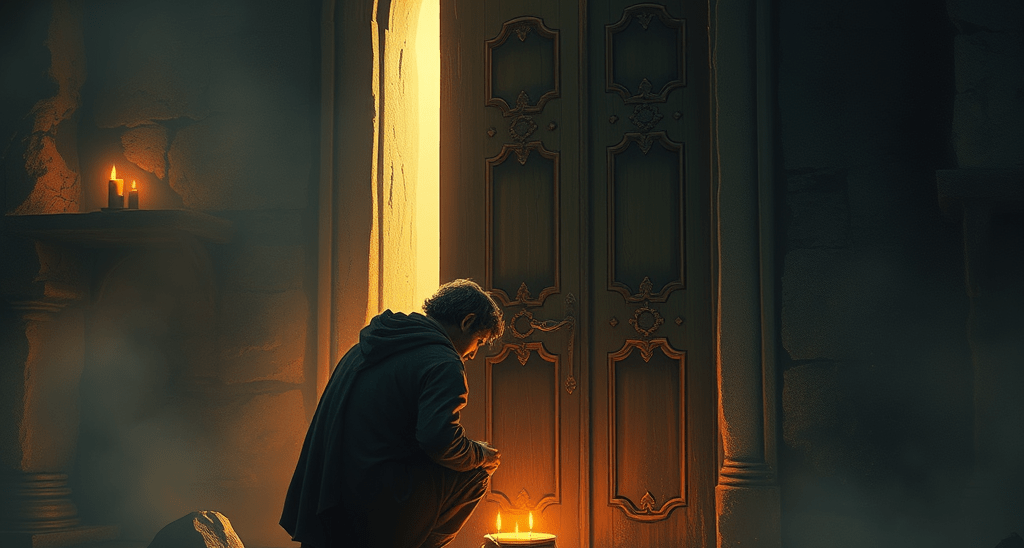
Listen! I am standing at the door, knocking; if you hear my voice and open the door, I will come in to you and eat with you, and you with me. Revelation 3:20

Jesus stands at the door, knocking (Revelation 3:20). In reality, he comes in the form of a beggar or a poor child in old, torn clothes, asking for help. He meets you in every person you see. As long as there are people, Christ will live on earth as your neighbor. Through them, God calls you, speaks to you, and asks you to act. This is the serious and blessed message of Advent. Christ stands at the door, living among us in the form of other human beings. Will you close the door or open it?

It might feel strange to see Christ in an ordinary face, but this is what he taught. If we ignore this serious Advent message, we cannot truly talk about Christ coming into our hearts.

Christ is knocking. It is not yet Christmas, but it is also not the final Advent—the last coming of Christ. In every Advent season of our lives, there is a deep hope for that final Advent, when Christ will say, “Look, I am making everything new” (Revelation 21:5).

Advent is a time of waiting, but in a way, our whole life is like an Advent season. We wait for the last Advent, the time when there will be a new heaven and a new earth.

We can, and should also, celebrate Christmas despite the ruins around us.… I think of you as you now sit together with the children and with all the Advent decorations—as in earlier years you did with us. We must do all this, even more intensively because we do not know how much longer we have.

Letter to Bonhoeffer’s parents, November 29, 1943,
written from Tegel prison camp

Bonhoeffer, Dietrich. God Is in the Manger : Reflections on Advent and Christmas. Louisville, Presbyterian Publishing Corporation, 2012.

Advent: Day 28 – The Spirit of Christmas

“How will this be,” Mary asked the angel, “since I am a virgin?”
The angel answered, “The Holy Spirit will come on you, and the power of the
Most High will overshadow you.” 
Luke 1:34-35


You hear a lot about the spirit of Christmas at this time of year. But the spirit of Christmas needs to be superseded by the Spirit of Christ

The spirit of Christmas is annual; the Spirit of Christ is eternal. The spirit of Christmas is sentimental; the Spirit of Christ is supernatural. The spirit of Christmas is a human product; the Spirit of Christ is a divine person. These distinctions make all the difference in the world. 

The angel explained to Mary that she was actually going to experience the birth of Christ through the Holy Spirit in her life. The angel said to her that the power of the Almighty, through the Holy Spirit, was going to rest upon her. The baby to be born of Mary would be the One whose kingdom would never end. This light of Christ wouldn’t just flash into Mary’s life and then die away. With the coming of this child, God was about to establish His eternal kingdom. 

Christ can also be born in our lives. It is through the Holy Spirit that we are born again. It is a supernatural, spiritual work that makes us children of God, brought into His family and kingdom. The apostle Paul wrote to the Christians living in Galatia, “My dear children, for whom I am again in the pains of childbirth until Christ is formed in you” (Gal. 4:19). Paul was not talking about an annual event, but about a perpetual indwelling. The Spirit of Christ in us is not sentimental, beginning and ending with a sweet baby in a manger, but it is supernatural, powerful, and life-changing.

Living in the Spirit of Christ does not mean that people try hard to be more noble, good, and kind for a specific season every year. No. For Christians, God is, in Christ, reconciling the world to Himself. The Holy Spirit enables people to be what they’re not and to do what they can’t. The Spirit of Christ is actually God, in Christ, through the Holy Spirit, being born in the lives of people, in all times and seasons. 

Let us concentrate on experiencing the Spirit of Christ from now to next Christmas— and throughout the many years and Christmas seasons to come. The spirit of Christmas will come and go and be glamorized and trivialized. But all the while, the Spirit of Christ is being born into one person after another, and God’s eternal kingdom is being established in our lives.

Advent: Day 27 – The Crib, Cross, and Crown (Part 2) 

“Whoever wants to be my disciple must deny themselves and take up their cross
daily and follow me.” 
Luke 9:23


The crib, the cross, and the crown are fundamental to who Jesus is. Similarly, they’re fundamental to the Christian life as well. 

Think of the crib as a place where the miracle of rebirth and regeneration takes place. Being born again is fundamental to our spiritual experience. But the crib isn’t enough. If Christ has been born in us, we must grow and mature as His disciples. Jesus said: 

Taking up our cross means submitting our wills to God’s will. Jesus willingly accepted God’s will for our sake, and it cost Him His life. Those who invite Jesus Christ into their lives must identify with the will of God as surely as Christ identified Himself with the eternal purposes of the Father. 

Our society has fallen ill to the disease of meaninglessness, a sickness that leads to hopelessness and superficiality. So many people have given in. “Life is falling apart,” they say. “I’m just not going to think about it.” Yet just below the surface, a fear about the future eats away at us. We can’t completely avoid the nagging issues of life. 

Christians, however, need not remain in such a “Slough of Despond.” For believers there is not only a crib and a cross, but the sure promise of a crown. We live through all eternity with the risen, ascended King of kings and Lord of lords—who wears a glorious crown. And we too will receive crowns for faithful service to Him. 

Now then, this produces a different breed of person in society. Instead of focusing on the material world—worrying about politics or the nasty people we must deal with; trying desperately to preserve our youth because we’re so frightened of aging; tightly gripping all that we own because that’s all we’ve got—we can live confidently and with hope because we live in light of the crown. 

Those without a crib have yet to experience new life in Christ. Those without a cross have not given over their self-centered lives in exchange for the abundant God-centered life. And those without a crown have no depth or sense of hope. Crib, cross, and crown—are all three present in your life? 

Advent: Day 26 – The Crib, Cross, and Crown (Part 1) 

“Father, the hour has come. Glorify your Son, that your Son may glorify you… I have
brought you glory on earth by finishing the work you gave me to do. And now, Father,
glorify me in your presence with the glory I had with you before the world began.”
John 17:1,4-5


There’s something beautiful and delightful about the birth of the Christ child. Each Christmas season there is opportunity—for a short time, at least—to concentrate not on the suffering and sin we see in our world, but on the beautiful baby in the crib. And of course, the beauty of this baby’s birth led to the wonder of the Savior’s life. 

But as we contemplate the innocent baby’s birth, which led to the sinless Savior’s life, we arrive at a very unpleasant conclusion: The life Jesus lived ultimately condemns the life we live. When we evaluate our lives against His, we can only admit the hopelessness and helplessness of our condition. We can’t live as He lived, and we can’t undo the consequences of our own shortcomings. 

If we look only at the crib, we arrive at a point of despair. For the beautiful crib led to Jesus’ majestic and superb example—and that leads us to a sense of helpless inadequacy. Yes, a crownless crib leads to hopelessness. 

If we read Scripture very carefully, we will recognize that before the crib there was the “crown” of Jesus. The baby that was born in Bethlehem shared glory with the Father before the world began. And after the cross, that crown was replaced. In other words, the earthly life and ministry of Jesus served as an interlude in His eternal reign as the Lord of all glory. And though His life ultimately reveals our hopelessness, the death and resurrection by which He took back His crown is the light of hope that shines on our darkness.

We should always beware of the doctrine of the crownless crib. We cannot really consider the Son of God in a crib apart from His cross and His seat upon the throne of heaven. For if we forget these we will lose our sense of who Jesus really is and what He has accomplished.