
Advent: December 22 – Living By God’s Mercy

In this you rejoice, even if now for a little while you have had to suffer various trials, so that the genuineness of your faith—being more precious than gold that, though perishable, is tested by fire—may be found to result in praise and glory and honor when Jesus Christ is revealed. Although you have not seen him, you love him; and even though you do not see him now, you believe in him and rejoice with an indescribable and glorious joy, for you are receiving the outcome of your faith, the salvation of your souls.
1 Peter 1:6–9

We cannot approach the manger of the Christ child the same way we approach the cradle of any other child. When we come to his manger, something profound happens. We cannot leave unchanged. We are either judged or redeemed. At this manger, we must either break down under its truth or experience the mercy of God reaching out to us.

What does this mean? Is it just a poetic way of speaking? Is it an exaggeration of a sweet and pious story? What does it mean that such powerful things are said about the Christ child?

Some people may dismiss these words as just symbolic or exaggerated. They will continue to celebrate Advent and Christmas as before, with the same casual indifference, as if it is just another holiday. But for us, these words are not just poetic language. This is the incredible truth: God himself— the Lord and Creator of all things—is here in this small child. He is hidden in a quiet corner of the world, entering the simplicity and plainness of human life. In the weakness and vulnerability of a child, God meets us and wants to be with us.

This is not done for the sake of sentimentality or because we find it emotionally moving. God reveals himself this way to show us who he is and where he chooses to be. From this humble place, God challenges, judges, and overturns all human pride and ambition.

God’s throne in this world is not found in the powerful places or on the seats of kings and rulers. Instead, it is in the lowliest of places: a manger. And around this throne, we do not see wealthy, flattering servants. Instead, we see poor, unknown, and doubtful figures—people who marvel at this miracle and who want to live entirely by God’s mercy.

“Joy to the world!” Anyone for whom this sound is foreign, or who hears in it nothing but weak enthusiasm, has not yet really heard the gospel. For the sake of humankind, Jesus Christ became a human being in a stable in Bethlehem: Rejoice, O Christendom! For sinners, Jesus Christ became a companion of tax collectors and prostitutes: Rejoice, O Christendom! For the condemned, Jesus Christ was condemned to the cross on Golgotha: Rejoice, O Christendom! For all of us, Jesus Christ was resurrected to life: Rejoice, O Christendom!… All over the world today people are asking: Where is the path to joy? The church of Christ answers loudly: Jesus is our joy! (1 Pet. 1:7–9). Joy to the world!

Dietrich Bonhoeffer

Bonhoeffer, Dietrich. God Is in the Manger : Reflections on Advent and Christmas. Louisville, Presbyterian Publishing Corporation, 2012.
Advent: December 21 – The One Who Became Human

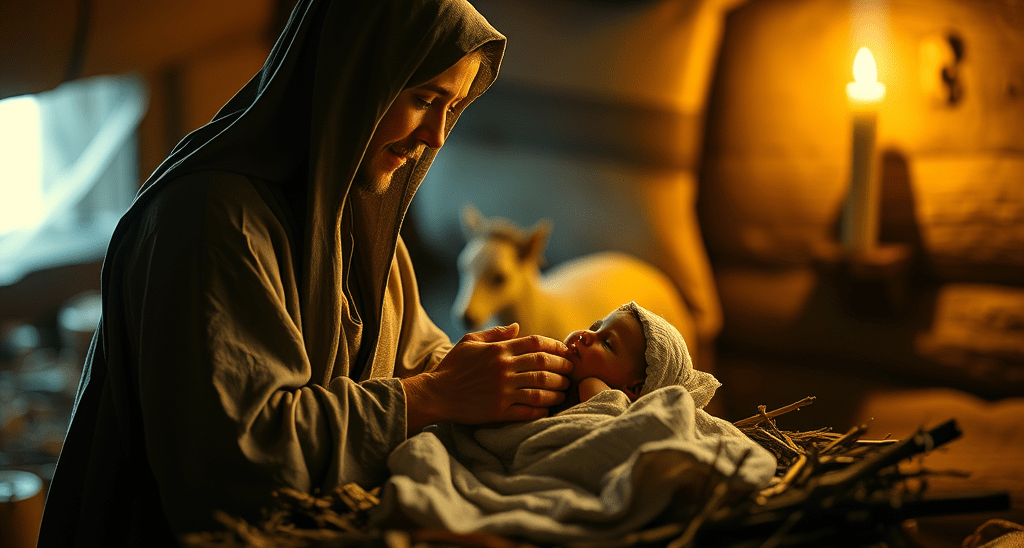
In those days a decree went out from Emperor Augustus that all the world should be registered. This was the first registration and was taken while Quirinius was governor of Syria. All went to their own towns to be registered. Joseph also went from the town of Nazareth in Galilee to Judea, to the city of David called Bethlehem, because he was descended from the house and family of David. He went to be registered with Mary, to whom he was engaged and who was expecting a child. While they were there, the time came for her to deliver her child. And she gave birth to her firstborn son and wrapped him in bands of cloth, and laid him in a manger, because there was no place for them in the inn.
Luke 2:1–7

Who is this God? This is the God who became human, just like us. He is fully human. Because of this, nothing about being human is unfamiliar to him. The person I am, Jesus Christ also was. When we talk about Jesus Christ, we say: this man is God.

This does not mean we already understood who God is. It also does not mean that saying, this man is God, adds something extra to being human. God and humanity are not naturally connected by any concept or definition. Instead, saying this man is God means something entirely different. The divinity of Jesus Christ is not something added on top of his humanity. The statement this man is God comes as a truth from above. It does not change anything about Jesus Christ’s humanity but shows that this whole human being is God.

Faith comes from seeing Jesus Christ as a human being. When we describe Jesus Christ as God, we do not focus on ideas like omnipotence (all-powerful) or omniscience (all-knowing). Instead, we think of his cradle and his cross. God is not defined by being all-powerful or everywhere at once. Instead, God is revealed in Jesus Christ’s life, death, and love for humanity.

And now Christmas is coming and you won’t be there. We shall be apart, yes, but very close together. My thoughts will come to you and accompany you. We shall sing “Friede auf Erden” [Peace on Earth] and pray together, but we shall sing “Ehre sei Gott in der Höhe!” [Glory be to God on high] even louder. That is what I pray for you and for all of us, that the Savior may throw open the gates of heaven for us at darkest night on Christmas Eve, so that we can be joyful in spite of everything.

Maria von Wedemeyer to Bonhoeffer,
December 10, 1943

Bonhoeffer, Dietrich. God Is in the Manger : Reflections on Advent and Christmas. Louisville, Presbyterian Publishing Corporation, 2012.
Advent: December 20 – The Unfathomably Wise Counselor

But when the fullness of time had come, God sent his Son, born of a woman, born under the law, in order to redeem those who were under the law, so that we might receive adoption as children. And because you are children, God has sent the Spirit of his Son into our hearts, crying, “Abba! Father!” So you are no longer a slave but a child, and if a child then also an heir, through God.
Galatians 4:4–7

The name of this child is “Wonderful Counselor” (Isa. 9:6). In him, the greatest wonder of all has happened: the Savior’s birth came from God’s eternal plan. God gave us his Son in the form of a human child. God became human; the Word became flesh (John 1:14). This is the incredible wonder of God’s love for us. It is through this wise and Wonderful Counselor that we are saved and won over by God’s love.

Because this child of God is the Wonderful Counselor, he is also the source of all wonders and all wisdom. For those who see Jesus as the Son of God, every one of his actions and words becomes a wonder. They find in him the deepest, most meaningful, and most helpful answers to all their needs and questions.

Even before this child can speak, he is already full of wonder and wisdom. Go to the child in the manger. Believe that he is the Son of God, and you will find wonder after wonder, and counsel after counsel.

In winter it seems that the season of Spring will never come, and in both Advent and Lent it’s the waiting that’s hard, the in-between of divine promise and its fulfillment.… Most of us find ourselves dangling in this hiatus, which in the interval may seem a waste of time.… But “the longer we wait, the larger we become, and the more joyful our expectancy.” With such motivation, we can wait as we sense that God is indeed with us, and at work within us, as he was with Mary as the Child within her grew.

Poet Luci Shaw, in God with Us

Bonhoeffer, Dietrich. God Is in the Manger : Reflections on Advent and Christmas. Louisville, Presbyterian Publishing Corporation, 2012.
Advent: December 19 – God Becomes Child

And the Word became flesh and lived among us, and we have seen his glory, the glory as of a father’s only son, full of grace and truth.
John 1:14

The name of this child is “Mighty God” (Isa. 9:6). The baby in the manger is God himself. Nothing greater can be said: God became a child. In the baby Jesus, born to Mary, the almighty God lives.

Stop for a moment! Don’t speak; don’t think! Be still and listen to these words: God became a child! Here he is, poor like us, weak and helpless like us, a human being with flesh and blood like us—our brother. And yet, he is still God; he is mighty.

Where is the power of this child? Where is his divinity? It is in his love, the divine love that made him become like us. His poverty in the manger is his might. Through the power of this love, he closes the gap between God and humans, defeats sin and death, forgives our sins, and brings life after death.

Kneel before this poor manger, before this child born to a poor family, and say with faith the words of the prophet: “Mighty God!” Then he will be your God and your strength.

But now it is true that in three days, Christmas will come once again. The great transformation will once again happen. God would have it so. Out of the waiting, hoping, longing world, a world will come in which the promise is given. All crying will be stilled. No tears shall flow. No lonely sorrow shall afflict us anymore, or threaten.

Sermon to a German-speaking church in Havana, Cuba, December 21, 1930

Bonhoeffer, Dietrich. God Is in the Manger : Reflections on Advent and Christmas. Louisville, Presbyterian Publishing Corporation, 2012.

Advent: December 18 – The Great Turning Point of All Things

What then are we to say about these things? If God is for us, who is against us? He who did not withhold his own Son, but gave him up for all of us, will he not with him also give us everything else? Who will bring any charge against God’s elect? It is God who justifies. Who is to condemn? It is Christ Jesus, who died, yes, who was raised, who is at the right hand of God, who indeed intercedes for us.
Romans 8:31–34

What kings, leaders of nations, philosophers, artists, founders of religions, and teachers of morals tried and failed to do—this now happens through a newborn child. A child is placed at the center of world history, putting to shame the greatest human efforts and achievements. This child is born of human beings but given by God (Isa. 9:6). This is the mystery of the world’s salvation; everything from the past and everything in the future is contained here.

The infinite mercy of the all-powerful God comes down to us in the form of a child—his Son. That this child is born for us, that this Son is given to us, that this human child and Son of God belongs to me, that I know him, have him, love him, that I am his and he is mine—this is what my life now depends on. A child holds our life in his hands.

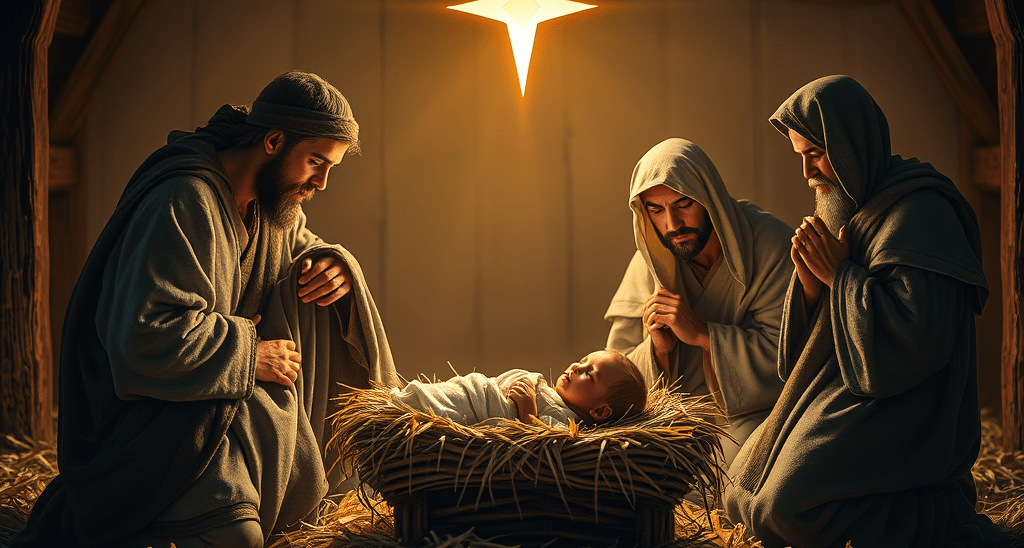
How shall we deal with such a child? Have our hands, soiled with daily toil, become too hard and too proud to fold in prayer at the sight of this child? Has our head become too full of serious thoughts … that we cannot bow our head in humility at the wonder of this child? Can we not forget all our stress and struggles, our sense of importance, and for once worship the child, as did the shepherds and the wise men from the East, bowing before the divine child in the manger like children?

“The Government upon the Shoulders of the Child,” Christmas 1940

Bonhoeffer, Dietrich. God Is in the Manger : Reflections on Advent and Christmas. Louisville, Presbyterian Publishing Corporation, 2012.